
A North of France Road Trip That Feels Like Traveling Through Time
- The Travel Moment

- Feb 7
- 8 min read
Updated: Feb 9

This isn't the France of vineyards and lavender fields.
This is the France of dramatic coastlines, half-timbered villages that lean into cobbled streets, and abbeys rising from tidal islands. The north unfolds differently.
Days here shift between wild Atlantic air and the stillness of medieval towns. Between vast horizons and streets so narrow you instinctively lower your voice.
This North of France road trip moves through Normandy and Brittany in a loop from Paris, designed for travelers who want contrast without chaos.
Seven days. Four or five overnight bases. Enough time to let each place settle before moving on.
It's built for those who value the drive as much as the destination, and who understand that a good trip isn't about how much you see, but how clearly you remember it.
HOW THIS ROUTE WORKS
You leave Paris heading west toward the coast, moving through medieval Rouen before reaching the cliffs.
From there you curve inland through Norman countryside, visit wartime memory sites, then loop south into Brittany's medieval heart.
The return brings you to Honfleur's harbor before closing the circle back to Paris.
The rhythm changes as you move. Coastal drama, then calm villages. Open roads, then winding stone streets. Days when you cover ground, and days when staying still feels like the right choice.
You'll change hotels three or four times across the week. Enough to see different regions without the constant fatigue of packing and unpacking.
Most drives between stops take around two hours, which leaves your mornings and evenings open rather than spent behind the wheel.
This route works best if you're comfortable on narrower European roads and you care more about atmosphere than checking off landmarks. There's structure here if you want it. There's also room to wander.
WHAT YOU'LL NEED
You'll need a car for the full seven days. Renting from Paris and returning there keeps logistics simple.
When choosing a rental, full insurance coverage matters more than it might seem.
Road trips are meant to feel freeing, not stressful. Knowing you're covered if something small goes wrong (a scratch in a tight village street, a chip from a coastal road) removes the low-level worry that can quietly affect how much you enjoy the drive.
It's worth choosing a rental company with clear policies and reliable support, especially if you're unfamiliar with European driving or don't want to spend mental energy managing worst-case scenarios.
THE ITINERARY
DAY 1: PARIS TO ÉTRETAT VIA ROUEN
First glimpse of medieval and coastal Normandy

Leave Paris mid-morning when the roads feel open and the city is still waking up.
The drive to Rouen takes about 90 minutes, just enough time to shift from city rhythm to something slower.
Stop in Rouen for lunch and a walk through the old quarter. The cathedral sits at the heart of narrow medieval streets that feel like they belong to another century.
The Gros-Horloge, a clock tower over a stone archway, has been marking time here for hundreds of years.
An hour or two here gives you a sense of the city without rushing, and breaks the journey before continuing to the coast.
From Rouen, it's another hour to Étretat.
Arrive by mid-afternoon with time to walk toward the cliffs before dinner.
The village sits smaller and quieter than you might expect, tucked between dramatic white rock formations and the sea.
Stay Base: ÉTRETAT OR FÉCAMP for 2 nights
Étretat works for travelers who want to wake up near the cliffs.
Fécamp suits those who prefer calm and fewer seasonal crowds.
Make it easier
Take your time in Rouen. A slower lunch and an unhurried walk make the first day feel less like traveling and more like arriving.
DAY 2: ÉTRETAT
Cliffs and sea air

Spend today at the coast without moving hotels or covering ground.
Étretat's cliffs are what people come here for. The arches and needle rock formations rise from the sea with a quiet drama that never quite translates to photographs.
Walk the clifftop trail early in the morning or late in the afternoon. Midday brings crowds that shift the feeling.
The scenic route along the coast reveals small beaches between headlands if you want to drive.
Viewpoints appear without warning. But the main event is the cliffs themselves, and they reward multiple visits at different hours.
Lunch at a crêperie overlooking the water. An early dinner while the evening light is still good.
If sunset looks promising, walk back to the cliffs one more time. The glow changes everything.
Make it easier
Try a seafood restaurant beyond the crêperies. Fresh catch and Norman cider make the day feel more grounded in the place.
DAY 3: ÉTRETAT TO BAYEUX
Inland calm and wartime memory

The drive takes about 90 minutes and moves you inland through green Normandy countryside. Farms, apple orchards, villages that feel untouched by hurry.
Stop in Beuvron-en-Auge on the way. It's one of France's officially classified beautiful villages, with half-timbered houses in faded colors and a central square that feels frozen in a gentler time.
If you arrive hungry, stop for lunch. The village sits on the Cider Route, which means local cider, calvados, and Norman dishes like slow-cooked pork or apple tarts with cream.
If your timing aligns with the spring Geranium Festival or autumn Cider Festival, the square comes alive with producers and tastings.
You won't need long here, just enough to walk, eat, and breathe before continuing.
Arrive in Bayeux by late afternoon. Check in, then walk the old town center as the day softens. Visit the Bayeux Tapestry if history calls to you, or simply wander the medieval streets.
Dinner somewhere local and unhurried.
Bayeux feels grown-up in the best way.
Stay Base: BAYEUX (2 nights)
Bayeux rewards elegant, historically grounded stays. Properties that feel refined without being formal, often family-run.
DAY 4: BAYEUX AND THE D-DAY BEACHES
Reflection and wide open skies

Spend today based in Bayeux. How you spend it depends on what pulls you.
If modern history calls to you:
Drive to Omaha Beach, one of the main D-Day landing sites from June 1944 during World War II. The beach is wide, open, and holds that historical memory with remarkable calm.
Walk the shoreline, then visit the American Cemetery at Colleville-sur-Mer, which overlooks the beach from the cliffs above. Explore Utah Beach and Pointe du Hoc for more D-Day sites, they are nearby and equally powerful.
If you'd rather stay in the medieval:
Spend the full day in Bayeux. Walk the old town slowly, visit smaller streets away from the center, or drive to nearby villages like Longues-sur-Mer.
Bayeux rewards time without agenda. Either way, return to town by mid-afternoon.
Spend the evening quietly. This is a good day to move slowly and let the morning settle.
Stay Base: Bayeux (second night)
Make it easier
Spend the afternoon in one of Bayeux's tea rooms with local products like homemade cakes. For dinner, look for coquilles Saint-Jacques (scallops) on the menu. They're typical of the region and most restaurants know how to prepare them well.
DAY 5: BAYEUX TO DINAN VIA MONT SAINT-MICHEL
The tidal abbey

Stop at Mont Saint-Michel on the way.
The abbey sits on a tidal island where the bay shifts between sand and sea depending on the hour.
Walk the causeway toward it, the fortress grows closer with each step, rising higher until the medieval village surrounds you.
The narrow streets wind upward through stone archways and small shops until you reach the abbey itself. From here, the bay stretches in every direction.
When the tide is out, the sand goes on for what feels like miles. When it's in, water surrounds the island completely. The light changes the feeling of everything.
Mornings tend to be quieter, especially on weekdays and outside peak season. If you prefer fewer people, leaving Bayeux early helps.
If you want the night view and a quiet morning walk, stay near Mont Saint-Michel. Quiet countryside inns with bay views let you see the abbey lit after dark and return at dawn when the causeway feels almost private.
Otherwise, continue to Dinan and arrive by late afternoon. If the weather is good, walk the old ramparts as the sun sets.
The cobbled streets of the old town, particularly Rue du Jerzual, slope steeply down toward the river.
Dinan reveals itself slowly, which suits it.
Stay Base:
MONT SAINT-MICHEL AREA
If you want to stay near Mont Saint-Michel rather than just pass through, choose a quiet countryside inn with views of the bay, not the busier village itself.
DINAN
Dinan offers charming stays within or just outside the medieval walls. Look for character over modern polish here.
DAY 6: DINAN AND SURROUNDINGS
Stone streets and river views

Stay based in Dinan today, with the option to explore nearby if the mood strikes.
Walk the old town in morning light. The streets feel quieter, the details sharper.
The port area at the base of Rue du Jerzual makes for a calm riverside walk or a café stop that stretches as long as you want.
If you want to move, Saint-Malo is thirty minutes away. The coastal town has fortified walls, afternoon light on stone, and the kind of atmosphere that suits a few hours of wandering.
Return to Dinan for dinner.
Stay Base: Dinan
Make it easier
Skip Saint-Malo and stay entirely in Dinan. It's small enough to explore without effort and rewards a slower pace.
DAY 7: DINAN TO PARIS VIA ROUEN
Return through the harbor
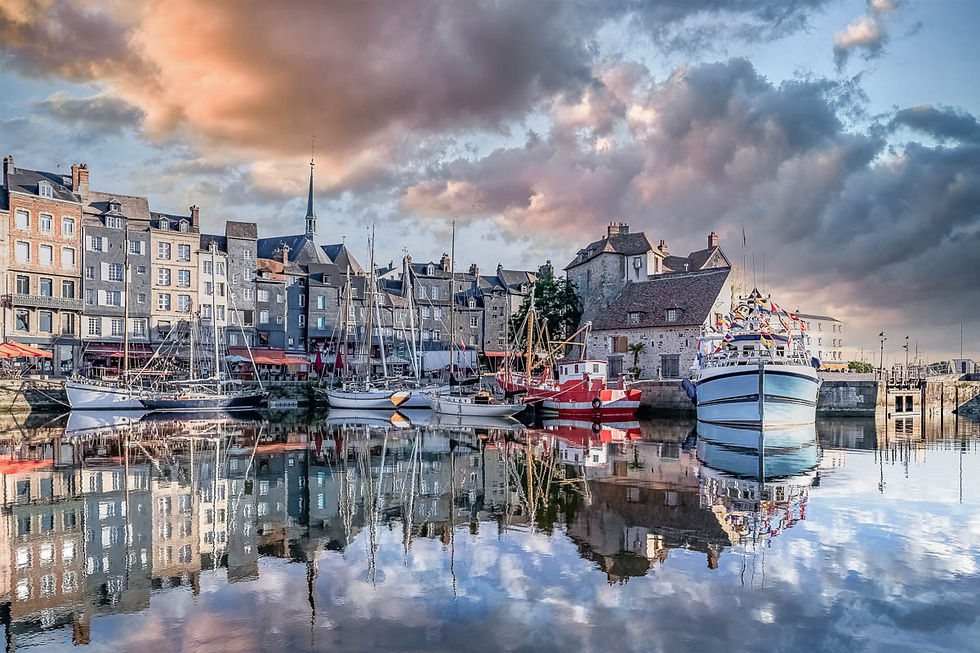
Leave Dinan early enough to arrive in Honfleur by late morning. The drive takes about two and a half hours.
Honfleur sits on the coast with a calm, unhurried energy. The old harbor is lined with tall, narrow houses that lean slightly toward the water.
Walk the smaller streets that branch off from the main square. Stop at a café when you feel like sitting. Have lunch near the water as the light shifts.
If you have time before continuing to Paris, Deauville is twenty minutes away. The beach boardwalk there works well for a late afternoon walk. But Honfleur itself doesn't ask for much.
From Honfleur to Paris takes around two hours. Arrive back by early evening, depending on when you leave and how long you linger.
Make it easier
Around Honfleur's Vieux Bassin, pick a seafood restaurant with harbor views and go for what the town does best: oysters, mussels and a classic Norman fish stew or scallops when in season. If you want something more local, duck into a creperie-cidrerie for buckwheat galettes and a glass of farmhouse cider before you leave.
IS THIS THE RIGHT ROAD TRIP FOR YOU?
This route works well if:
You want a trip that feels visually varied without being geographically scattered
You're comfortable with three to four hotel changes across a week
You value atmosphere and pacing over checking off famous landmarks
You enjoy driving as part of the experience, not just a way to get somewhere
You prefer towns and coastlines to cities and nightlife
This is the kind of trip that stays with you quietly. Not because of one standout moment, but because of how the days built on each other.
The contrast between clifftop air and medieval stillness. The rhythm of mornings that started slowly and evenings that felt earned.
If this route resonates, save it. When you're ready to plan the rest of your France trip, the Paris neighbourhoods post will help you decide where to stay before or after the drive.

Comments